Leadership & team development

You don't need better people. You need people put in a position to be better.

Clear roles, real accountability, developed managers, and incentives that reward the right things — we build the leadership layer that lets your company run on more engines than just yours.

Leadership built from your own crew wherever possible — promoting beats recruiting

300+businesses served nationwide
Top 1%consultant recognition
2×1written net-profit guarantee
The symptoms

When everything escalates to the owner, nothing is actually managed.

Most $1M–$10M companies don't have a lazy-team problem. They have a structure problem: unclear roles, no scoreboard, and managers promoted for being great technicians but never taught to manage.
  • Your best field guy became a supervisor — and now you have a mediocre supervisor and lost your best field guy
  • Two people think they own the same decision; three problems have no owner at all
  • Meetings happen when things break, not on a rhythm that prevents breaks
  • Raises and bonuses reward loyalty and tenure, not results
  • Accountability means "the owner gets upset," not a number with a name on it
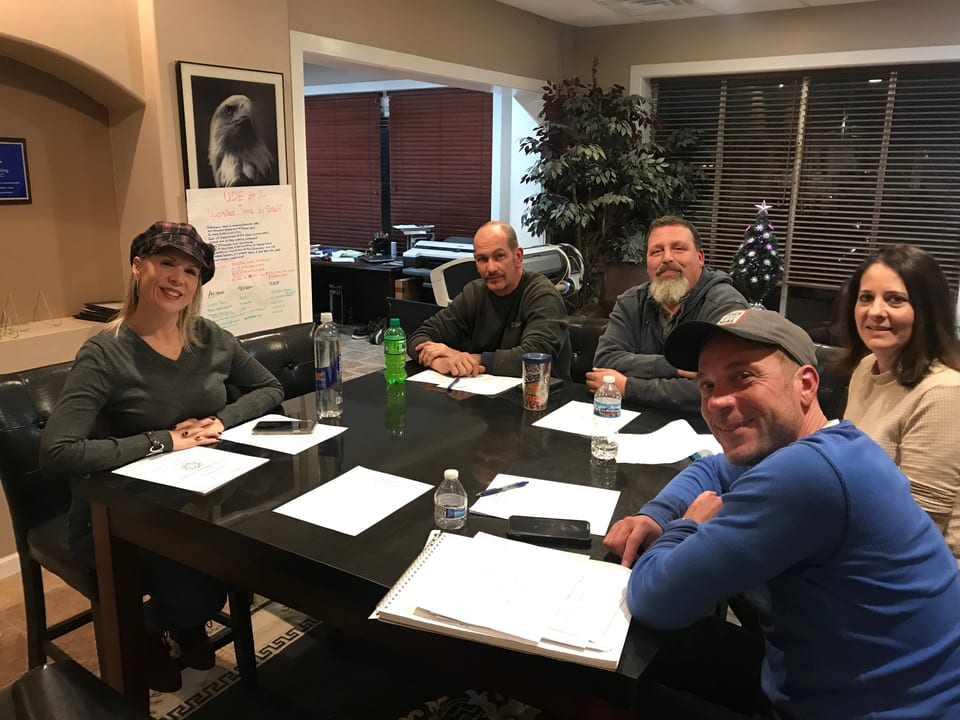
A client company holding its first management team meetingClient's business

A client's first real management meeting.

What we build

From crew with a boss to company with a management team

Accountability structure

An org design based on the work, not the personalities — every key result owned by exactly one seat, with the authority to deliver it.

Manager development

Hands-on coaching for your first-line and senior managers: running meetings, setting expectations, giving feedback, managing numbers instead of moods.

Incentive & bonus programs

Compensation engineered around margin, quality, and retention — like the driver performance bonus programs we've designed for transportation clients — so the team wins when the company wins.

Meeting & scorecard rhythm

A weekly management meeting with a scorecard that surfaces problems while they're small — replacing firefighting with a cadence.

Hiring & promotion system

Defined roles, real interviews, structured onboarding — so the next hire is a decision, not a gamble on a warm body.

Owner transition

A deliberate hand-off of decisions from you to the team, one category at a time — the foundation for owner freedom.

“Armando possesses a wide range of talents and knowledge that not only improves your business.”
Jeff VanPamelDiscover Plumbing
Weekly remote management meetings, Critical Path Methodology, cash management reporting, and a bonus and incentive program — established and running.
Northern Tier TransportationEngagement outcomes
Is this you?

For owners carrying the whole management load alone

This engagement fits if…

  • Every decision above "routine" still escalates to you, and your managers relay problems instead of owning them
  • You promoted your best technician into a supervisor seat and now both the seat and the technician are underperforming
  • Good people keep walking out the door, and the exit conversations all sound suspiciously alike
  • Raises and bonuses get negotiated one-off in your office, rewarding tenure and squeaky wheels instead of results
  • There's no standing management meeting — or there is one, and it's a status recital nobody would miss

It's probably not the right fit if…

  • You're a solo operator or have only a couple of employees — start with our delegation framework and build toward a first management layer
  • You're pre-revenue — SCORE's free mentoring is the right resource at that stage, and it's one Armando volunteers in as a Certified Mentor
  • You're after a one-day team-building event or a personality-test workshop, not months of structural change and manager coaching
  • You're not actually ready to let managers make decisions — structure without delegated authority is theater
Leadership FAQ

Common questions

My managers are maxed out already. How do they take on more?
They're maxed out because they're doing their old job plus half of an undefined new one. Clear seats, delegated decisions, and a working meeting rhythm typically give managers hours back within weeks — that's the capacity the development work grows into.
Should I hire an operations manager from outside?
Sometimes — but it's the most expensive option and the most likely to fail if the structure underneath is unclear. We usually fix the structure first, develop the internal candidates, and only then recruit for the seats no one inside can fill. More on that sequence here.
Do bonus programs actually work for field crews and drivers?
Yes — when they're tied to numbers the crew can influence and see weekly. Programs that pay out annually on company-wide profit don't change Tuesday's behavior. We design incentives at the level where behavior happens. Our design principles are here.
What if the problem is a specific person — a manager who isn't working out?
Structure first, then people decisions. Once the seat is defined and measured, an underperformer either rises to the standard, moves to a seat that fits, or the decision makes itself — with documentation instead of drama. You'll handle it with a plan either way.
What does leadership development like this cost?
There's no rate card, because no two management teams need the same depth of work. After the free assessment we scope the engagement — structure, coaching hours, incentive design — and put a price on that specific plan. It comes with our written 2×1 net-profit guarantee, so the projected return is on paper before you sign anything. How the guarantee works.
What happens in the first two weeks of an engagement?
Structured one-on-ones with you, every manager, and key employees; a hard look at who actually owns which results today versus what the org chart claims; and a seat in (or the launch of) your first real weekly management meeting. By the end of week two you have a written structure diagnosis and a development plan per manager — before any coaching begins, so the coaching aims at the right gaps.
Won't adding accountability make people quit?
Usually the opposite. Most turnover in $1M–$10M companies is driven by unclear expectations, invisible scoreboards, and managers who were never taught to manage — the pattern we break down in employee turnover and management problems. Fair standards with a visible scoreboard tend to keep your best people, because they finally get credit for being your best people. The few who leave under a fair scoreboard are rarely the ones you needed to keep.
Can you develop our managers remotely, or do you have to be here?
In Dallas–Fort Worth we're on-site with your team. Nationwide, engagements run on immersion visits plus a weekly remote cadence — the same model behind the Northern Tier Transportation outcomes: weekly remote management meetings, Critical Path Methodology, cash management reporting, and a bonus and incentive program, all established and running from a distance.
Related insights

Go deeper on leadership

Every dollar you invest returns at least two in net profit. Guaranteed.

That is our 2×1 guarantee. Complete the short qualifying application and get a free, no-obligation business assessment with an accredited consultant.

Start your free assessment